EV range in winter
In winter, cabin heating takes most of the range, and a cold battery charges more slowly on a fast charger.
Translated from Serbian. Where the exact wording matters, the Serbian original applies.
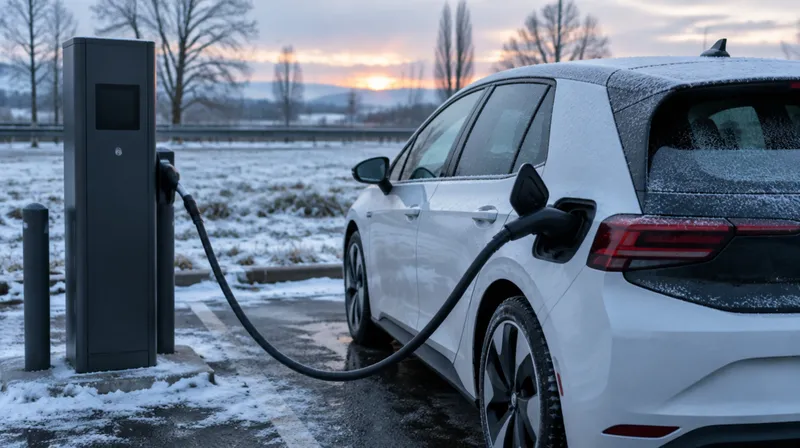
- At 0 °C an electric car keeps on average 78 % of its range, depending on the model 69–88 %
- January in the plains of Serbia is around 0 °C, in Belgrade 0,4 °C on average
- Heating the cabin air uses 3.000–5.000 W, heated seats and steering wheel about 75 W
- A heat pump gives about 10 % more range at 0 °C
- Most cars heat the battery for fast charging only when the charger is the destination in the car's navigation
How much range you lose
At 0 °C an electric car covers on average about four fifths of the range it has at 21–27 °C. Most of the difference goes to heating the cabin and the battery. The loss is temporary: when it gets warmer, the range comes back.
| Terms | Range |
|---|---|
| 0 °C, average of 34 models | 78 % of maximum |
| 0 °C, best and weakest model | 88 % and 69 % |
| Around −7 °C, heating on | about 41 % less than at 24 °C |
| Motorway, 0 °C | consumption on average 57 % above WLTP |
Details: tests and colder parts of Serbia
- ADAC, driving at 0 °C: the Renault Zoe and Peugeot e-208 each used 21 % more than in summer, the VW ID.3 about 30 % more.
- ADAC long-term tests: in winter consumption was 25–31 % higher, depending on the car.
- ADAC motorway 2026, 0 °C: the Audi A6 Avant e-tron performance covered 441 km at 23,2 kWh/100 km. Its WLTP range is 719 km.
- Green NCAP: the Cupra Born drops from 328 km in warm weather to 221 km in the cold, the BYD Sealion 7 from about 400 km to 337 km.
- Norway, El Prix 2026: 24 cars at temperatures down to −32 °C covered on average 38 % less than their WLTP figures.
- Serbia, January (RHMZ, averages 1961–1990): up to 300 m above sea level from −1,0 to 0,0 °C, the Timok region and basins down to −3,0 °C, at 300–500 m from −3,0 to −1,0 °C, above 1.000 m from −6,0 to −3,0 °C.
- Recurrent's data are from the USA. A model's maximum range is measured there at 21–27 °C.
Heating: the biggest difference
- Heated seats and steering wheel use about 75 W, cabin air heating 3.000–5.000 W.
- Warm up the cabin while the car is plugged in. The heat then comes from the grid, not from the battery.
- A heat pump gives about 10 % more range at 0 °C. When buying, check whether the model has one.
- Recirculation warms the cabin faster. Open doors and windows as little as possible.
Details: how much heating takes
- AAA, around −7 °C: with heating on, range was about 41 % lower than at 24 °C. Without climate control the loss averaged up to 12 % (2019 test).
- BMW i3 in Recurrent's test: without heating 20 % less range in the cold, with heating 50 % less.
- Recurrent (InsideEVs): with a heat pump cars keep 83 % of their range at 0 °C, without one 75 %. A Tesla Model 3 with a heat pump keeps 87 %, without one 79 %.
- A heat pump does not produce heat like an ordinary heater, it moves it, so it uses less electricity.
Charging at a public charger in winter
- Charge after driving, while the battery is warm. According to ADAC, fast charging in the evening after a drive is better than charging in the morning before setting off.
- Enter the charger as the destination in the car's navigation. Navigation on a phone does not start battery heating.
- Heat the cabin while charging. After charging ends, Charge&GO and Orion on their own chargers allow 15 minutes, then charge 5 RSD per minute.
- Keep a bigger reserve. ADAC advises using the reserve after the warning only in an emergency.
Details: a cold battery on a fast charger
- A battery takes power fastest at 20–40 °C.
- ADAC, −7 °C: without a preheated battery a Tesla stays at the charger 56 instead of 33 minutes, 70 % longer. How much slower other models charge and why: why a car charges slowly on a fast charger.
- In the El Prix 2026 test many cars with a preheated battery charged from 10 to 80 % in close to the stated time.
- In an ADAC measurement, heating the battery at a DC charger added 2–8 % losses.
- With per-minute billing, slower charging means a more expensive kWh: how to pay less at a public charger.
Driving and traffic jams
- Drive slower on the motorway. Speed can affect range more than temperature.
- Check tyre pressure once a month. It drops in the cold, and rolling resistance rises.
- Clear snow and ice before setting off. Extra weight and worse aerodynamics use up range.
- Avoid short trips with long breaks. The cabin and battery cool down and have to be warmed up again.
- In a traffic jam a car can heat for hours. The VW e-Up and Renault Zoe last 12 hours and more with a heated seat and 22 °C in the cabin.
Details: what uses almost nothing
- Radio and navigation use about 0,03 kW, which is about 180 m of range per hour.
- In a long traffic jam you save power with a lower cabin temperature and the heated seat instead of warm air.
- Chargers by city and along motorways: charger map, for example in Belgrade.
Sources (20)
- RHMZ Serbia — temperature regime (mean January temperatures, 1961–1990), checked 27.10.2026
- Recurrent — winter range of 34 models, 19.11.2025
- InsideEVs — Recurrent, heat pump and range at 0 °C
- Recurrent — heat pumps (BMW i3)
- ADAC — winter motorway range test, 22.01.2026
- Utopia — ADAC winter test, WLTP and measured range
- ADAC — electric car in winter: consumption and tips
- ADAC — fast charging and charging curves 2026
- ADAC — fast charging tips
- Utopia — ADAC, losses from battery heating at the charger
- Geotab — winter driving tips
- Benchmark.rs — AAA, range loss at −7 °C
- tportal — AAA, without climate control, 2019
- Greenfleet — El Prix 2026, Norway
- Revija HAK — Green NCAP in winter, 18.12.2025
- Volvo Cars — winter range, snow and ice
- Meinauto — ADAC, heating in a traffic jam
- EnBW — 7 winter tips
- Notebookcheck — ADAC, battery reserve
- Charge&GO — general terms of 26.06.2024 (idle fee after 15 minutes)
Updated 29.10.2026 · next check 28.11.2026 · Report an error
Related
First charge at a public charger
You need an app or a payment card, the right connector and the right order: with Charge&GO confirm first, with Orion…
Which plug your car has
The socket under the flap decides which public chargers your car can use and whether you need an adapter.
Why a car charges slowly at a fast charger
The charger shows its maximum power; how much you actually get depends on the battery, the car and the second connector.