Why a car charges slowly at a fast charger
The charger shows its maximum power; how much you actually get depends on the battery, the car and the second connector.
Translated from Serbian. Where the exact wording matters, the Serbian original applies.
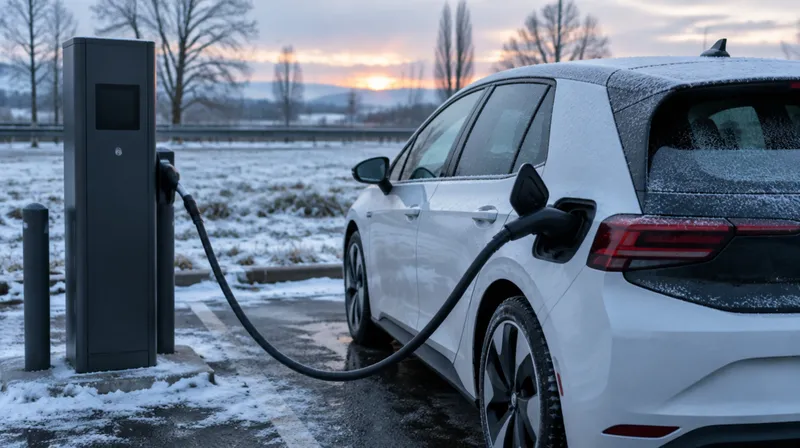
- The charger shows the maximum possible power, not the power you will certainly get. The car decides the speed.
- A battery charges fastest at about 20–40 °C. Colder or hotter, it takes less power.
- At −7 °C, without preconditioning, fast charging took 40–70 % longer in the ADAC test.
- When two cars charge on the same unit, power is usually split in half, for example 2 × 90 kW instead of 180 kW.
- A 400 V car takes at most about 200–240 kW through a CCS cable, however powerful the charger.
Cold or hot battery
The fastest charging is only possible within a certain battery temperature range, usually 20 to 40 °C, and higher for some models. Outside that range the car reduces power itself.
In winter, with a battery cooled overnight, do not count on anything close to full power. In the ADAC test the VW ID.3 started charging at −7 °C with less than 50 kW. At 23 °C it briefly takes 125 kW.
The solution is battery preconditioning. It is switched on through navigation to the charger or manually, a few minutes before arrival.
Details: winter test and summer
- ADAC, −7 °C, battery not preconditioned: the Tesla Model Y heated its battery for about 18 minutes before it started charging. It spent 56 minutes at the charger instead of 33, i.e. 70 % longer. The VW ID.3 charged 50 % longer, the Renault Zoe and VW e-Up 40 % longer each.
- Driving and temperature: according to Fastned, driving does not warm the battery the way it warms a combustion engine. The battery usually stays close to the outside temperature.
- Temperature is not shown: cars usually do not display the battery temperature.
- Summer: in heat, the warmth produced by fast charging is not removed quickly enough, so the battery management system reduces power.
Two cars on one charger
When two cars are plugged into one unit, the power is shared between them. Most often it is halved, but more and more stations distribute power as needed.
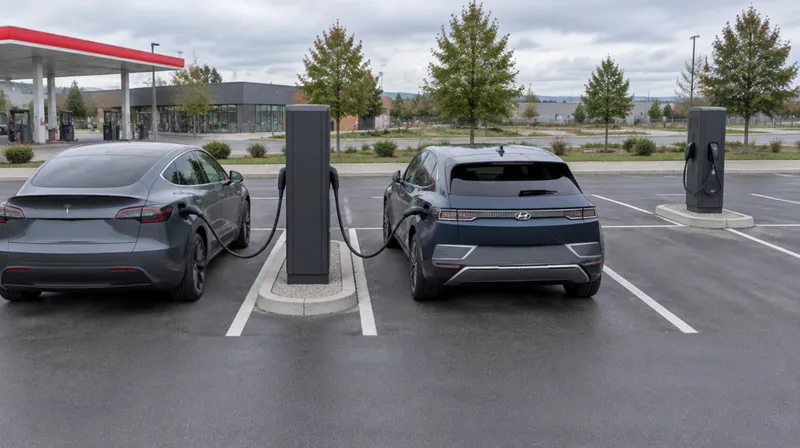
Examples of Charge&GO chargers in Serbia, both with two CCS connectors:
| Charger | One car | Two cars |
|---|---|---|
| OMV Martinci 1, motorway (Kostad Siemens Unity 180) | 180 kW | 2 × 90 kW |
| OMV Kruševac (Kostad Siemens) | 130 kW | 2 × 65 kW |
If another car is already charging on a unit, choose a completely free one whenever you can.
Details: when sharing matters less
- If your car takes at most 50 kW, half of 180 kW (90 kW) is still more than that, so sharing does not slow down charging.
- Charger power and whether chargers are free can be seen in the network's app and on the charger map.
Voltage and software
Power is voltage multiplied by current. The CCS plug is designed for 500 A continuous and 600 A short-term. That is why a 400 V car has a natural limit of about 200 to 240 kW.
An 800 V car can charge at a 400 V unit, but at half the power, unless it has an extra solution.
The car's software decides when and how the battery is heated. Manufacturers change it with updates.
Details: examples of voltage and software
- Voltage rises during charging: at 500 A, with a battery voltage of 350 V the car takes 175 kW, and at 400 V — 200 kW.
- 800 V car: Hyundai states that the IONIQ 5 charges at both 400 V and 800 V chargers, without an adapter. The 84 kWh version charges from 10 to 80 % in 18 minutes at 350 kW, and in 1 h 16 min at 50 kW.
- Kia EV6, 2022 model: preconditioning was added by a software update at an authorised service centre. It works only when the battery is colder than 21 °C and charged to at least 24 %. It switches on when a DC charger is set in the navigation; it cannot be switched on manually. In ideal conditions the EV6 charges from 10 to 80 % in 18 minutes, and at 5 °C, without preconditioning, in about 35 minutes.
What to check
- How much your car takes. The maximum DC power is in the car's specifications.
- Battery charge level. The emptier the battery, the higher the power. Charging works best from 10 to 80 %. More: how to pay less at a public charger.
- Preconditioning in winter, through navigation to the charger.
- A free unit, where no other car is charging.
- The display after the start. Before you walk away from the car, check that charging is running and that the power is as expected.
- The car's software. Check that the latest updates are installed.
If charging does not start at all: charger not working.
Details: why 350 kW on the charger does not mean 350 kW
- The charger and the app always show only the maximum possible power.
- You usually get the maximum power from the carmaker's data only when the battery is almost empty and it is warm outside. Fastned records the best results when it is warmer than 20 °C outside.
- You can safely use a charger more powerful than your car, because the car decides the power.
- If your car takes little power and a weaker free unit is nearby, ADAC advises leaving the fast unit to cars that can use its power.
Sources (10)
- ADAC, 07.08.2025 — fast charging tips: battery temperature 20–40 °C, summer, power sharing, checking the display
- ADAC — power split in half, preconditioning before arrival, battery temperature not displayed
- ADAC, 18.03.2026 — fast charging curves, test at −7 °C
- ADAC — 400 or 800 V, CCS 500 A continuous and 600 A short-term
- Edison, 17.11.2025 — an 800 V car at a 400 V charger
- Fastned — the car decides the speed, temperature, driving and the battery
- Energetski portal, 02.01.2023 — Charge&GO Unity 180, 2 × 90 kW
- Energetski portal, 19.04.2023 — Charge&GO OMV Kruševac, 2 × 65 kW
- Hyundai — IONIQ 5, charging at 50 and 350 kW, 400 and 800 V
- electrive, 21.10.2022 — Kia EV6, preconditioning via an update
Updated 20.10.2026 · next check 19.11.2026 · Report an error
Related
First charge at a public charger
You need an app or a payment card, the right connector and the right order: with Charge&GO confirm first, with Orion…
Which plug your car has
The socket under the flap decides which public chargers your car can use and whether you need an adapter.
How to pay less at a public charger
When you pay by the minute, a kilowatt-hour is cheapest while the car charges fastest, and that is in the lower half of the battery.