Where prices come from and why they differ
Prices come from the networks' apps and from receipts, with a date. Networks bill by the minute, so the price per kWh depends on the power at which your car charges.
Translated from Serbian. Where the exact wording matters, the Serbian original applies.
Where prices come from
Networks do not publish price lists on their websites, so the price can only be seen in the app. Once a month, prices are read from the networks' apps, with a dated screenshot, and from receipts for paid charging sessions.
When no price has been recorded at that particular charger, the card shows the same network's price for the same power. All recorded prices, with place and date, are on the Public charging page.
Why charging is paid per minute
Under Article 210v of the Energy Law, charging is a service, not a sale of electricity. The decree on metering has not yet been adopted, so networks charge for time.
That is why a kWh costs more when the car charges more slowly. A car that accepts 50 kW at a fast charger pays twice as much per kWh as a car that accepts 100 kW.
Same price per minute, two cars
price per kWh = price per minute × 60 ÷ power in kW
An example with a round price of 100 RSD per minute. The power is what the car actually accepts, not the charger's maximum power.
How to read the price on the map
When you zoom the map in to city level, the text next to a dot reads:
- “0 RSD”: charging is free;
- “56-60 RSD/kWh”: based on receipts from that charger no older than 90 days;
- “~68 RSD/kWh”: an estimate from the per-minute price, for the power a car really gets;
- “?”: the price is not known.
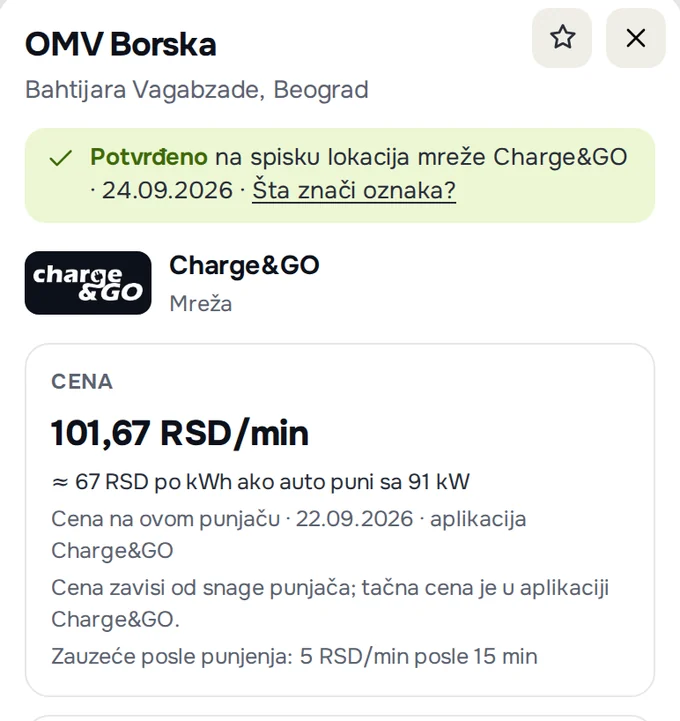
A grey label means the price is unknown or more than a year old. The card shows the price with its source and date, and an estimate, for example “≈ 68 RSD per kWh if the car charges at 90 kW”. An older price carries the warning “This price is more than a year old. Check it in the network's app.”
Details: which power the estimate uses
The estimate divides the per-minute price by the power a car really gets at that type of charger, not by the nameplate power: DC 30 kW → 30 kW, 50 → 45, 60 → 50, 110–120 → 90, 150–180 → 100, 240 → 130 kW; between those values the power is calculated proportionally. For an AC charger, 11 kW is used. Formula: price per minute × 60 ÷ power.
Why prices differ at the same station
- Roaming. The same charger can cost more in another network's app. At the Super Vero Novi Sad charger (DC 150 kW), on 22.09.2026: 197 RSD/min and a 140 RSD connection fee in the Orion eMobility app, but 114,17 RSD/min in the Charge&GO app.
- Connection fee. On its own chargers, Orion eMobility also charges 50 RSD per charging session.
- Idle fee after charging. Charge&GO and Orion eMobility charge 5 RSD per minute after 15 minutes.
- Unit. Emobility Spectra charges per “unit”, which is not a kWh.
The network's app shows the exact price before charging.
What to send
For a newer price, send a screenshot from the app to [email protected]; the corrections form accepts only text and a link. The screenshot should show:
- the station name and the charger's power;
- the price per minute, per kWh or the total amount on the receipt;
- the date and place.
You can cover your name, e-mail address and card number on the screenshot; they are not needed for the price.
Was this helpful?
Thank you for your feedback.
Sent. Thank you.
Sending failed. Write to [email protected].
Updated 28.09.2026 · Report an error in the text