Plug-in hybrid at a public charger
When you pay for time, a plug-in hybrid with a slow on-board charger pays the most expensive kilowatt-hour at the whole charger.
Translated from Serbian. Where the exact wording matters, the Serbian original applies.
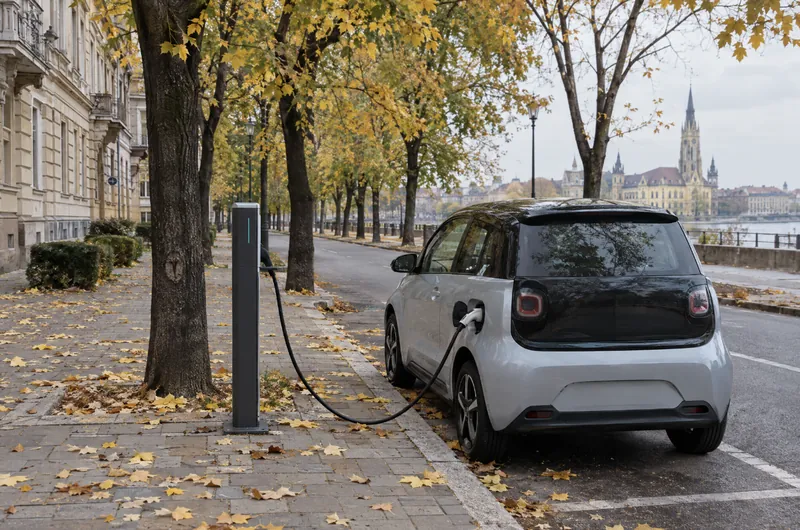
- A public AC charger bills time: Charge&GO AC 22 kW costs 1.000 RSD per hour, however much the car takes
- A plug-in hybrid takes 3,3–11 kW, so a kWh costs 91–303 RSD; at home at night roughly 4–7 RSD
- A 3,3 kW hybrid pays 303 RSD per kWh, more than a litre of petrol (207 RSD)
- It pays off for a hybrid that takes 11 kW AC or has a DC inlet, and at free chargers
- After charging you have 15 minutes, then occupying the charger costs 5 RSD per minute
The car's charger sets the price
The AC post says 22 kW, but the charger built into the car turns the power into battery charge. In plug-in hybrids it is small: usually 3,3–6,6 kW, 11 kW in newer models. The price of a kWh is: price per hour ÷ the power the car takes.
| Car draws | Example | Charge&GO AC | Orion AC, one hour |
|---|---|---|---|
| 3,3 kW | BYD Atto 2 DM-i Active | 303 RSD/kWh | 227 RSD/kWh |
| 3,7 kW | Outlander PHEV 2018–2020 | 270 RSD/kWh | 203 RSD/kWh |
| 6,6 kW | Atto 2 DM-i Boost, RAV4 PHEV | 152 RSD/kWh | 114 RSD/kWh |
| 11 kW | Seal U DM-i, Škoda Superb iV | 91 RSD/kWh | 68 RSD/kWh |
Details: prices and power by model
- Charge&GO: AC 22 kW, 16,67 RSD/min, i.e. 1.000 RSD per hour, VAT included.
- Orion eMobility: AC 22 kW at OMV Novi Sad, 700 RSD for 60 minutes + 50 RSD per session. The table shows one hour with the fee. At some Orion AC chargers a minute costs 30 RSD; a 3,3 kW car then pays about 560 RSD per kWh.
- BYD Atto 2 DM-i: Active 7,8 kWh and 3,3 kW; Boost 18 kWh and 6,6 kW.
- Toyota RAV4 Plug-in Hybrid: 18,1 kWh, 6,6 kW single-phase, no fast charging.
- Mitsubishi Outlander PHEV 2018–2020: 13,8 kWh (11,0 kWh usable), 3,7 kW single-phase.
- BYD Seal U DM-i and Škoda Superb iV: up to 11 kW AC.
- Look up your car's power in the manual or the specification under "AC charger" or "on-board charger".
Electricity or petrol
With a slow on-board charger, an hour at a public charger adds few kilometres.
- Atto 2 DM-i Active (3,3 kW): an hour of charging for 1.000 RSD gives about 17 km on electricity. The same 1.000 RSD buys about 4,8 litres of petrol, enough for about 90 km in hybrid mode.
- Atto 2 DM-i Boost (6,6 kW): 15 to 100 % takes up to 3 hours, i.e. up to 3.000 RSD at Charge&GO. That is about 3.900 RSD per 100 km on electricity, while petrol is about 1.060 RSD per 100 km.
Paid slow AC charging of a plug-in hybrid costs more than driving on petrol. Electricity is cheap at home or at a free charger.
Details: the calculation
- Electric range by WLTP: Active 40 km from 7,8 kWh, Boost 90 km from 18 kWh. That is about 20 kWh per 100 km. Charging losses are not included, so the real kWh costs more.
- From 15 to 100 % the Boost gets about 15,3 kWh, or about 76 km. For 3.000 RSD that is about 196 RSD per kWh in the battery.
- At Orion AC (OMV Novi Sad) the same three hours cost 2.150 RSD, about 2.800 RSD per 100 km.
- Petrol: BMB 95 at 207 RSD (25.09.–02.10.2026), WLTP consumption in hybrid mode 55 mpg, about 5,1 l per 100 km.
- At home at night, at 4–7 RSD/kWh, 100 km on electricity costs roughly 80–140 RSD.
When a public charger makes sense
- The car takes 11 kW AC. The Seal U DM-i and Superb iV pay 91 RSD/kWh at Charge&GO, the same as an 11 kW electric car.
- The car has a DC inlet. Choose the slowest DC charger: at Charge&GO DC 30–50 kW a minute costs 33,33 RSD, at 150 kW 114,17 RSD.
- The charger is free. State chargers on motorways, Lidl and IKEA: free chargers.
- Drive off straight away. A small battery fills quickly. After 15 minutes Charge&GO and Orion charge 5 RSD per minute.
Details: DC charging of plug-in hybrids
- BYD Seal U DM-i (18,3 kWh): DC up to 18 kW, 30 to 80 % in about 35 minutes. On DC 50 kW at 33,33 RSD/min that is about 1.170 RSD, about 128 RSD/kWh. On a 150 kW charger the same charge costs about 4.000 RSD, about 437 RSD/kWh. AC 22 kW is cheaper: 91 RSD/kWh.
- Škoda Superb iV (25,7 kWh gross): DC up to 50 kW, 10 to 80 % in about 26 minutes. On DC 50 kW that is about 870 RSD, about 48 RSD/kWh based on gross capacity. At 150 kW about 2.970 RSD.
- Mitsubishi Outlander PHEV has a CHAdeMO inlet; the newer European model (22,7 kWh) charges at up to 50 kW. Stations with a CHAdeMO connector are shown by the filter on the charger map.
- Why a faster charger costs more for the same car: how to pay less.
Sources (12)
- Charge&GO — per-minute prices in the app (AC 22 kW 16,67 RSD/min, DC), 22.09.2026
- Charge&GO — general terms (occupancy fee after 15 minutes)
- Orion eMobility — app (AC 22 kW OMV Novi Sad 700 RSD for 60 min + 50 RSD), 22.09.2026
- BYD Serbia — ATTO 2 DM-i (7,8 and 18 kWh, 40 and 90 km, up to 3 h from 15 to 100 %)
- BYD UK — ATTO 2 DM-i (AC 3,3 and 6,6 kW, WLTP fuel consumption 55 mpg)
- BYD Serbia — SEAL U DM-i (18,3 and 26,6 kWh, AC 11 kW)
- BYD UK — SEAL U DM-i (AC 11 kW, DC 18 kW, 30–80 % in 35 minutes)
- Škoda Storyboard — Superb iV (25,7 kWh, AC 11 kW, DC 50 kW, 10–80 % in about 26 minutes)
- Elbilgrossisten — Toyota RAV4 Plug-in Hybrid (6,6 kW single-phase, 18,1 kWh)
- EV Expert — Mitsubishi Outlander PHEV 2018–2020 (1×16 A, 3,7 kW)
- InsideEVs — Outlander PHEV for Europe (22,7 kWh, CHAdeMO up to 50 kW)
- Fuel prices from 25.09. to 02.10.2026 (BMB 95: 207 RSD)
Updated 01.10.2026 · next check 31.10.2026 · Report an error
Related
How to pay less at a public charger
When you pay by the minute, a kilowatt-hour is cheapest while the car charges fastest, and that is in the lower half of the battery.
Tolls and parking
Electric cars get a discount on motorway tolls, but there is no free parking in Belgrade, Novi Sad or Niš.
Free chargers in Serbia
Free charging in Serbia exists mostly on motorways, where payment is not yet regulated by law.